5 'til 12
Brian House and Sue Huang (Knifeandfork) 2006
BEALL CENTER FOR ART AND TECHNOLOGY, IRVINE, CA
2006 JANUARY 18 - MARCH 15
OPENING RECEPTION JANUARY 17, 6-9 PM
2006 JANUARY 18 - MARCH 15
OPENING RECEPTION JANUARY 17, 6-9 PM
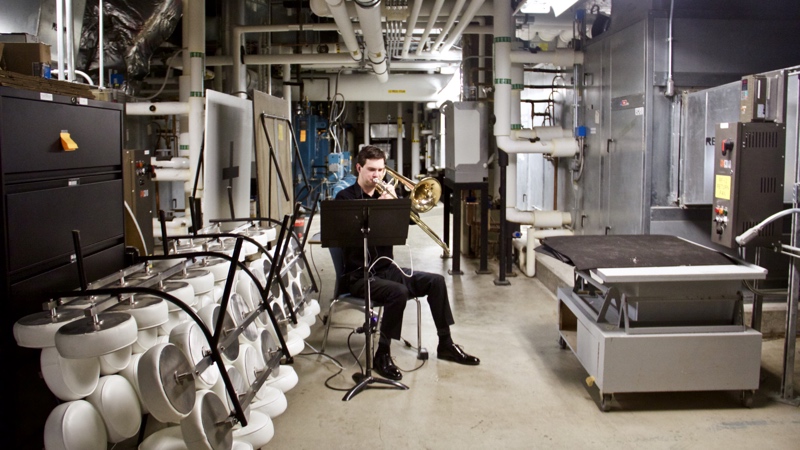
The Beall Center becomes the site of a nonlinear narrative with Knifeandfork's immersive installation, 5 'til 12. The visitor is invited to watch four characters, on four monitors, as they recount the tragic circumstances of the exhibition's opening night. The experience is unique for each visitor, as each story has most likely never been heard before... and won't ever be heard again.The premise is derived from Akira Kurosawa's film Rashomon, in which four eyewitness accounts of a murder are presented to the viewer, who serves in the role of a magistrate. The contradicting stories reveal that objectivity is elusive, as each individual cannot help but infuse his story, consciously or not, with personal shame and ambition. It is unclear who is lying, or if it matters. Each story holds a valid reality of its own, a subjective truth that reinforces a desired identity. However, perhaps there could be another layer: in addition to stories that differ between tellers, might an individual's story change with each new telling? 5 'til 12 proposes that we evolve multiple narratives as we explore multiple identities.
The process is inspired by the Oulipo literary movement, in particular the canonical piece by Raymond Queneau, One Hundred Thousand Billion Sonnets, in which 'potential' literature emerges when lines of words are spliced and recombined. 5 'til 12 draws from the artists' own journals, fantasies, and parodies, spoken aloud by the characters and filmed to create a database of cinematic possibilities. The clips are then algorithmically assembled during the exhibition, drawing from the enormous number of potential personas for each character. In total, the material in 5 'til 12 can be combined to form on the order of a googol squared possible variations on the narrative.
The characters themselves (represented by routines in the software) select from the possibilities in rounds, using a programmatic variation on the Prisoner's Dilemma, a model from game theory where individuals choose to cooperate or not in order to maximize their own personal advantage. Seeking to portray themselves in the best possible light, the characters must choose to be complimentary, neutral, or vindictive toward each other. One who appears confident and blameless while illustrating everyone else's faults will 'score' the highest. However, in the following round, he or she can expect revenge and must eventually make amends. The strategy of each character is adapted using an evolutionary algorithm according to its effectiveness in each round.
The installation uses RFID (Radio Frequency IDentification) cards to identify individual visitors. When each new visitor swipes a card, a new story is selected, and the visitor is recognized as he or she explores the narrative space.
Concept, engineering, writing, and production
Brian House,
Sue Huang
Audio-visual content and editing
David Feinberg
Performances
Amy Finkel,
Brian House,
Sue Huang,
Nathan Phillips
Additional writing
Amy Finkel,
Nathan Phillips,
Joe Schiappa
Construction
David Aeppli,
Paul
Documentary
David Feinberg
Documentary footage provided by
RSR Productions
Thanks to
Eleanore Stewart,
David Familian
Writing / press
Artificial Identiy, Synthetic Creativity
chapter in Deconstructing Installation Art
by Graham Coulter-Smith
2006
Turbulence: networked_performance
2006 January 19
we-make-money-not-art
2006 January 16
Grand Text Auto
2006 January 10
Squeeze OC
2006 January
Daily Pilot
2006 January 27
UC Spotlight
2006 April 3
chapter in Deconstructing Installation Art
by Graham Coulter-Smith
2006
Turbulence: networked_performance
2006 January 19
we-make-money-not-art
2006 January 16
Grand Text Auto
2006 January 10
Squeeze OC
2006 January
Daily Pilot
2006 January 27
UC Spotlight
2006 April 3