Yellow Arrow
Glowlab Conflux, Participant Inc., NYC
2004 May
Design and the Elastic Mind, MoMA, NYC
2008 February
7535 arrows, placed in 467 cities in 35 countries
2004 May
Design and the Elastic Mind, MoMA, NYC
2008 February
7535 arrows, placed in 467 cities in 35 countries
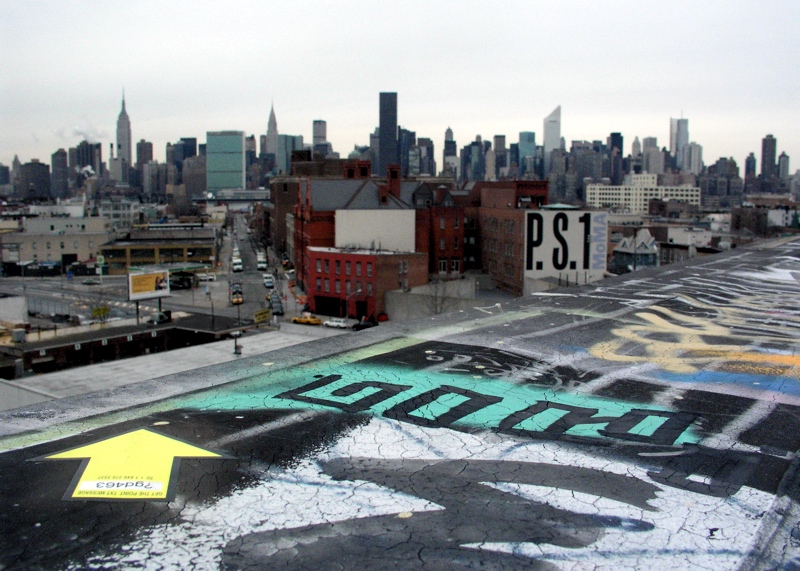
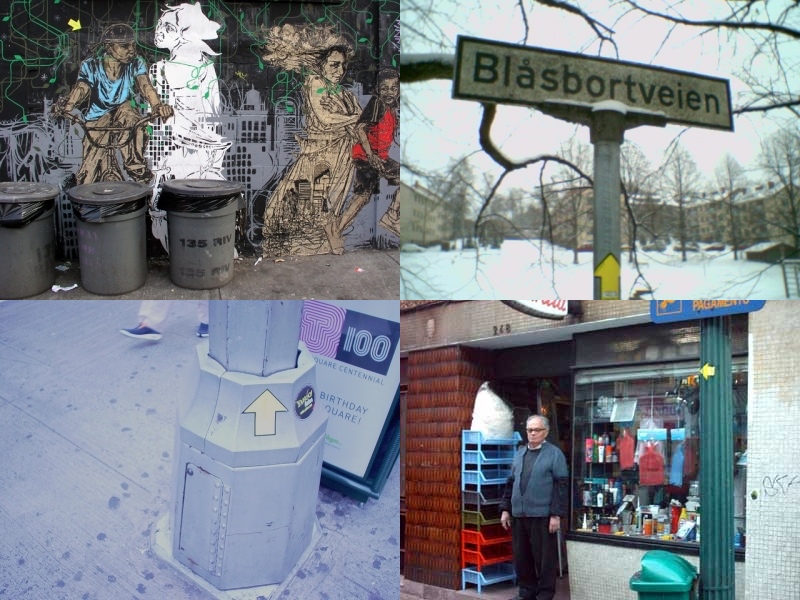
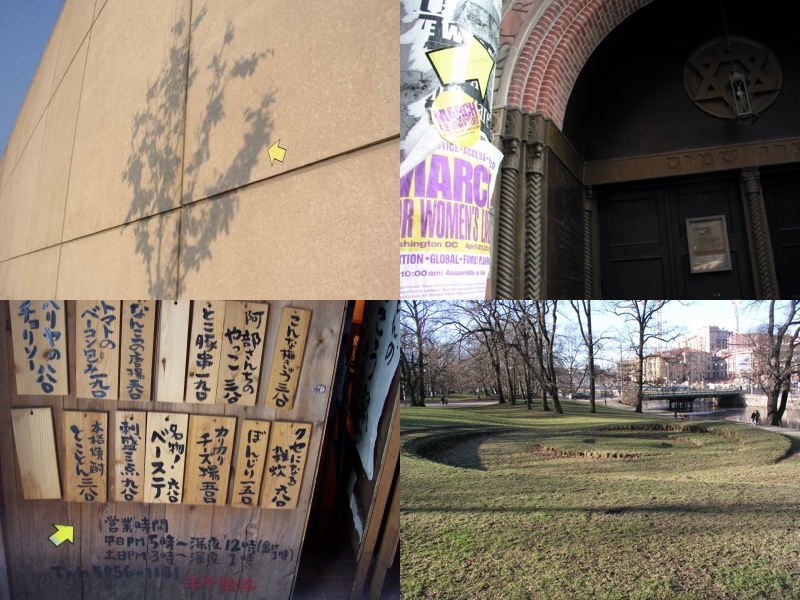
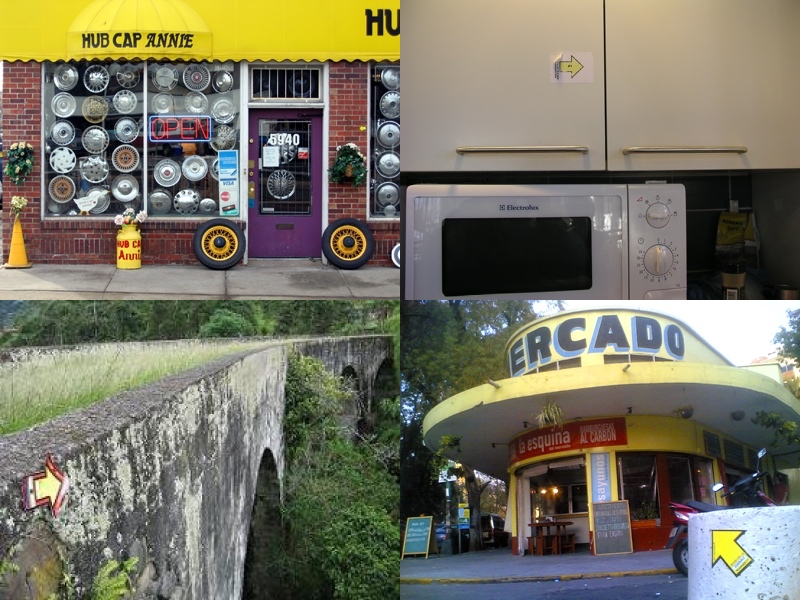
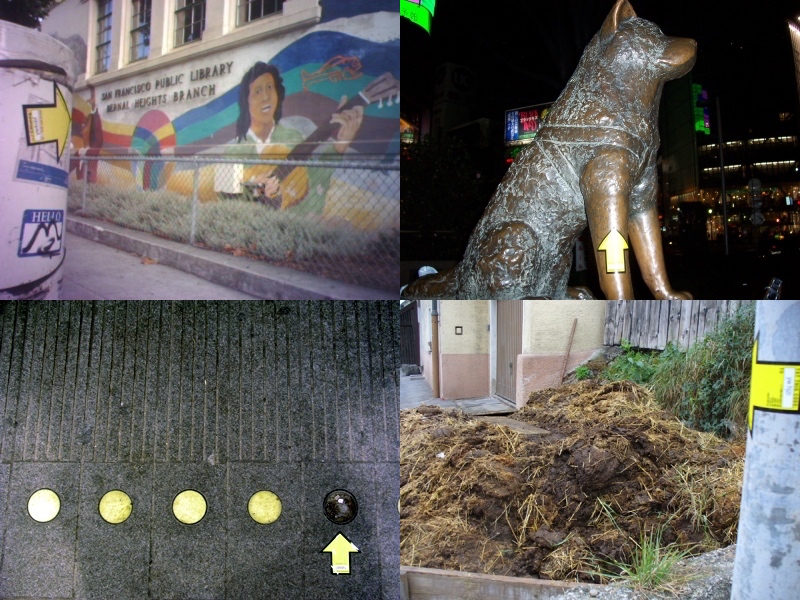
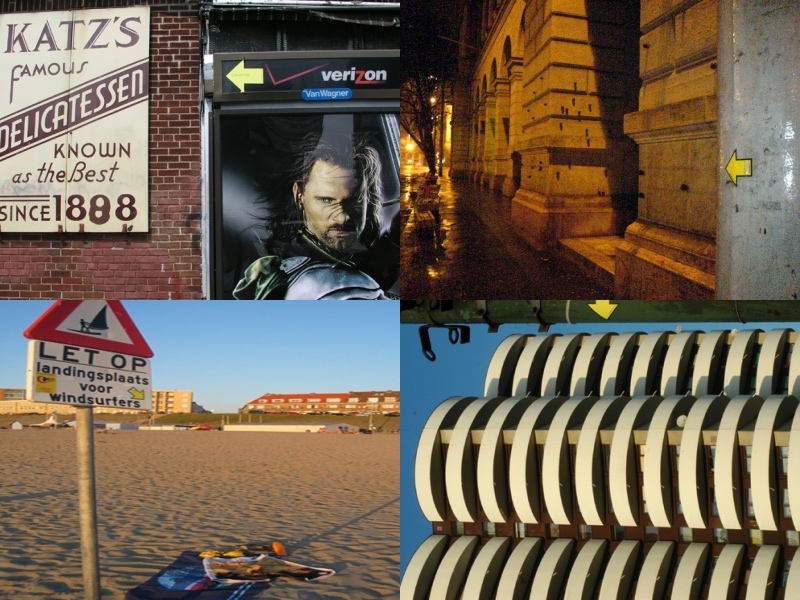
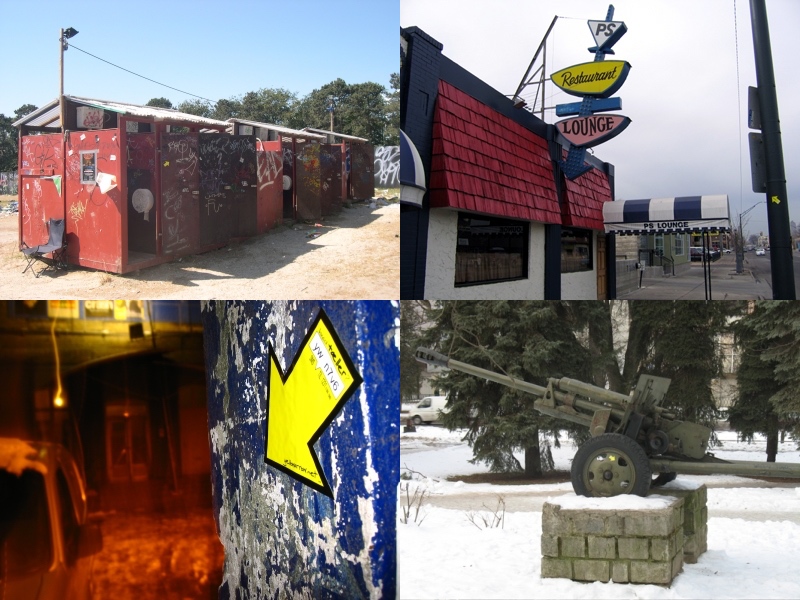
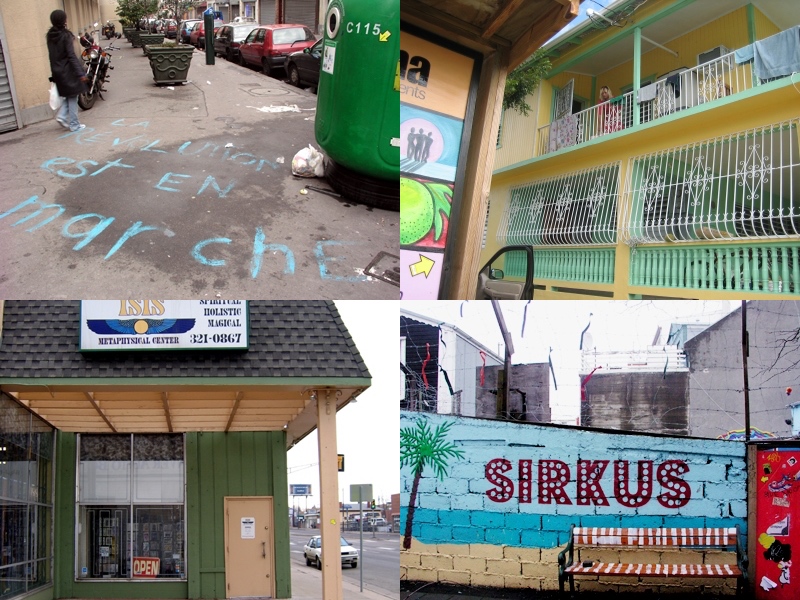
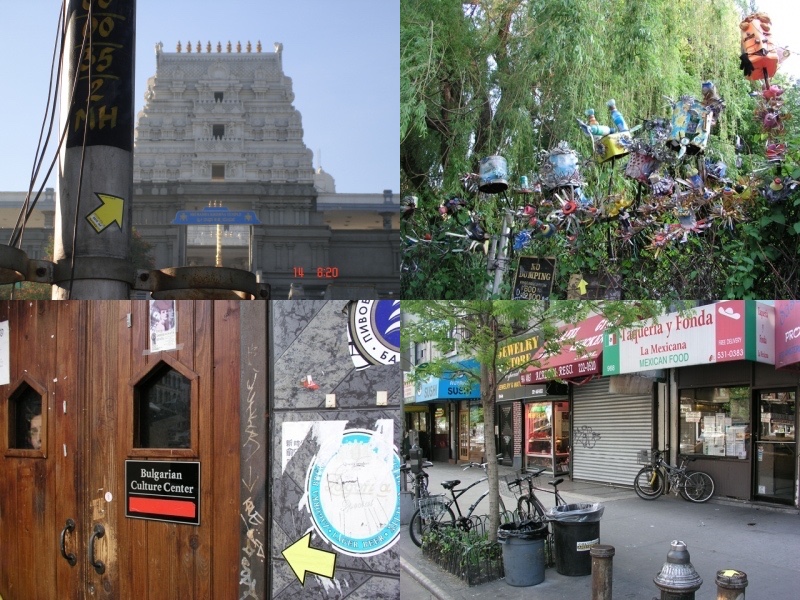
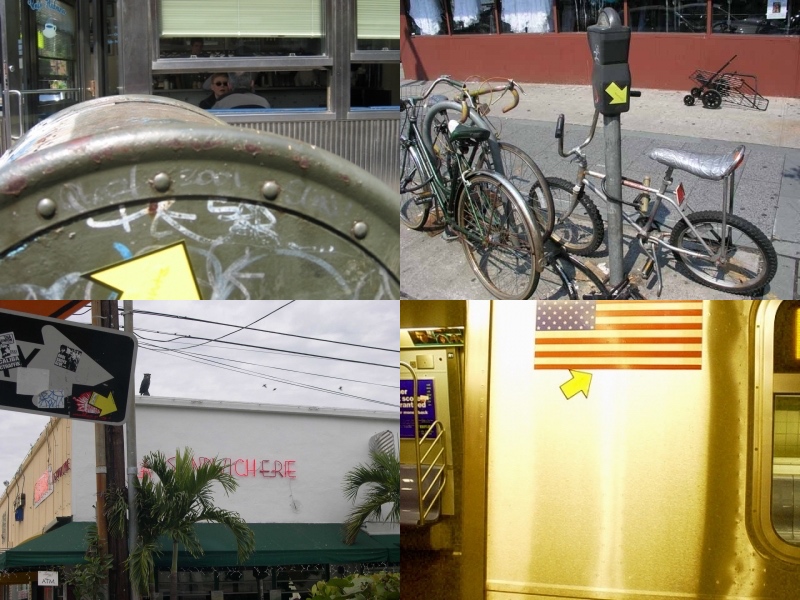
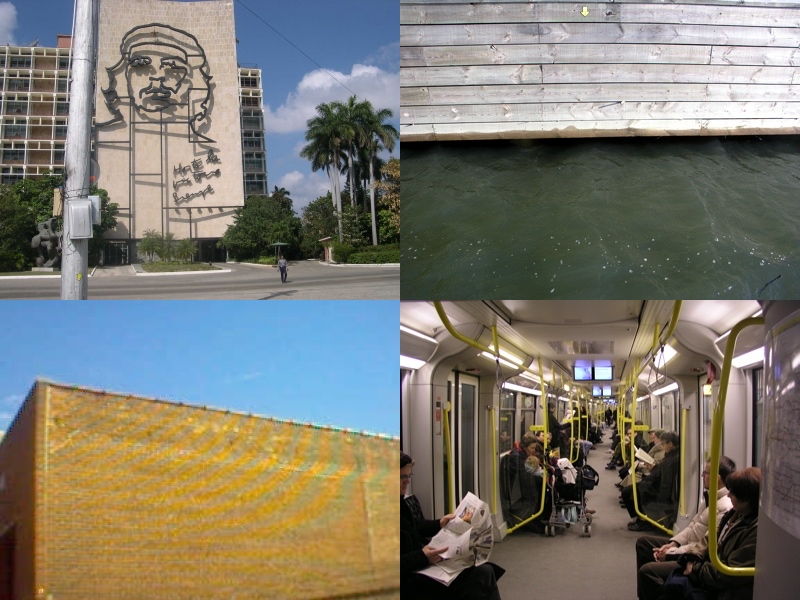
A harbinger of the "geospatial web," Yellow Arrow began in 2004 as a street art project on the Lower East Side of Manhattan, eventually growing to include participants in 38 countries around the world. The project prefigured Google Maps, Flickr, MySpace, Facebook, and geo-locative applications on smartphones by suggesting that social software, coupled with mobile devices and photography, could serve to radically redefine our conception of place. Stanford archaeologist and cultural theorist Michael Shanks writes that Yellow Arrow was an early example of "deep mapping cultural experience - a cartography of the intimate, the everyday, the monumental, the ephemeral, the epochal."From the original site: "Participants place uniquely-coded Yellow Arrow stickers to draw attention to different locations and objects - whether a back-alley mural, a favorite dive bar, or a new perspective on a classic landmark. By sending an SMS from a mobile phone to the Yellow Arrow phone number beginning with the arrow's unique code, Yellow Arrow authors essentially save a thought on the spot where they place their sticker. Messages range from short poetic fragments to personal stories to game-like prompts to action. When another person encounters the Yellow Arrow, he or she sends its code to the Yellow Arrow number and receives the message on their mobile phone. They can then reply to send a message to the author. The website yellowarrow.org extends this location-based exchange, by allowing participants to annotate their arrows with photos and maps in the online gallery of Yellow Arrows placed throughout the world. By collecting and sharing places of personal significance, this public collaboration expresses the unique characteristics, personal histories, and hidden secrets that live within our everyday spaces."
Along the way, Yellow Arrow incorporated many side projects and collaborations. These included: Capitol of Punk, an SMS and video tour of the 80s DC hardcore scene; South Harbor Voices, an initiative by Urban Task Force, an NGO in Copenhagen, working with mayoral candidates on urban revitalization; Guerilla Map Innsbruck, an investigation into alternative architecture in Austria conducted by Studio1; The Secret New York, featuring audio content by neighborhood characters marked by giant glowing Yellow Arrow sculptures; Clubarchaeology, by Posttourismusbüro in Berlin, documenting vanished nightlife; UrbanAdventours, a series of alternative trips in Boston by a local bike company; Heimat, exercises in the creative definition of 'home' by the Technical University of Darmstadt, Germany; Art Basel, a counter-exhibition on the streets of Miami and Basel, Switzerland; and Design Helsinki, a bottom-up curation of the design district. Yellow Arrow operated under the umbrella company Counts Media, which sought to produce art, theater, and games incorporating locative media. In 2006, the project was suspended, and all content was archived on Flickr.
The real revolutionary media were the walls and their speech, the silk-screen posters and the handpainted notices, the street where speech began and was exchanged - everything that was an immediate inscription, given and turned, spoken and answered, mobile in the same space and time, reciprocal and antagonistic. The street is, in this sense, the alternative and subversive form of the mass media, since it isn't, like the latter, an objectified support for answerless messages, a transmission system at a distance. It is the frayed space of the symbolic exchange of speech - ephemeral, mortal. — Baudrillard
Creators
Christopher Allen,
Brian House,
Jesse Shapins
Executive producers
Michael Counts,
Howard Pyle,
Jonathan Stern
Producers
Mohammed Abdul-Sattar,
Bill Ballou,
Lindsay Cook,
Dan Check,
Elizabeth Ellis,
Brian Fehd,
Tim Flateman,
Geoffrey Guinta,
Purva Mande,
Jamie McElhinney,
Kara Oehler,
Nathan Phillips,
Karenne Rossi,
George Surovov,
David Taylor,
Tomas Vengris,
Erin Wilson
Designers and developers
Sidney Blank,
Sertan Girgin,
Adam Mosseri,
Marco Raab,
Jean-Marc
Thanks to
Paola Antonelli,
Marion Barry,
Paul Bishow,
Gunvor Bottheim,
Alec Bourgeoise,
Jens Brandt,
Leslie Brown,
James Burns,
Brendan Canty,
Kareem Charles,
Leslie Clague,
Cynthia Connolly,
Martin Dahl,
Todd D'Amour,
Uffe Elbæk,
Dante Ferrando,
Martin Frandsen,
Dennis Frenchman,
Kimmy Gatewood,
Magne Gisvold,
Elizabeth Goodman,
Katrina Grigg-Saito,
Gesa Henselmans,
Sue Huang,
Mark Hurst,
Henry Jenkins,
Eugene Kim,
Dave King,
Carl-Johan Kjellander,
Andreas Knudsen,
Joe Lally,
Rasmus Laursen Johanna Linsley,
Alec Mackaye,
Ian Mackaye,
Steve Malkesethian,
Susan Malkesethian,
David Mandl,
Pouline Middleton,
William J. Mitchell,
Sipiwe Moyo,
Rehka Murthy,
Jeff Nelson,
Mats Nordahl,
Eric Paulos,
Katherine Predstrup,
Andrew Prescott,
Howard Rheingold,
Donna Rouse,
Sean Sacks,
Hilke Schellmann,
Susanne Seitinger,
Christina Ray,
Francisca Rojas,
Katie Salen,
Hilke Schellman,
Skyler Sullivan,
Ian Svenonius,
Jenny Tibbels,
Jordy Trachtenberg,
Kate Vallee,
Sudhir Venkatesh,
Allison Wolfe
Writing / press
WIRED
2004 September
New York Times
2006 January 25
Taiwan Daily News
2006 April
Washington Post
2005 July 2
Newsweek
2005 March
The Boston Globe
2005 April 18
Metropolis
2005 February
Politiken
2005 February 4
2004 September
New York Times
2006 January 25
Taiwan Daily News
2006 April
Washington Post
2005 July 2
Newsweek
2005 March
The Boston Globe
2005 April 18
Metropolis
2005 February
Politiken
2005 February 4